Brain facts — true or false?
Have a go at these seven quick brain facts. Read each statement, decide whether you think it is true or false, then tap to see the answer.

1. Multitasking means your brain is doing several tasks smoothly at exactly the same time.
True or false?
False — When we “multitask”, the brain usually switches quickly between tasks instead of truly running them all at once. That switching makes us slower and more likely to make mistakes, even if it feels like we’re doing several things together.

2. Because around 75% of the brain is made of water, even about 2% dehydration can affect how it works.
True or false?
True — The brain is largely water, so losing even a small amount through dehydration can change how well memory and attention work. That’s why drinking enough fluids helps your thinking stay sharp.
3. The human brain reaches full maturity by the age of 10.
True or false?
False — The brain grows very fast in early childhood, but it keeps developing through the teenage years and reaches full maturity around the mid-20s. So age 10 is far too early for a fully mature brain.

4. Humans only use 10% of their brains over the course of a day.
True or false?
False — Brain scans show that most areas of the brain are active at different times across a 24-hour period, including during sleep. The 10% idea is a myth — we use far more than that.

5. Short-term memory usually holds information for about 20 to 30 seconds, and there is a limit on how many items can be kept at once.
True or false?
True — Short-term or working memory keeps a small amount of information briefly available, often for only tens of seconds. There’s a limit on how many digits or letters we can hold at once, which is why things like phone numbers are kept short.
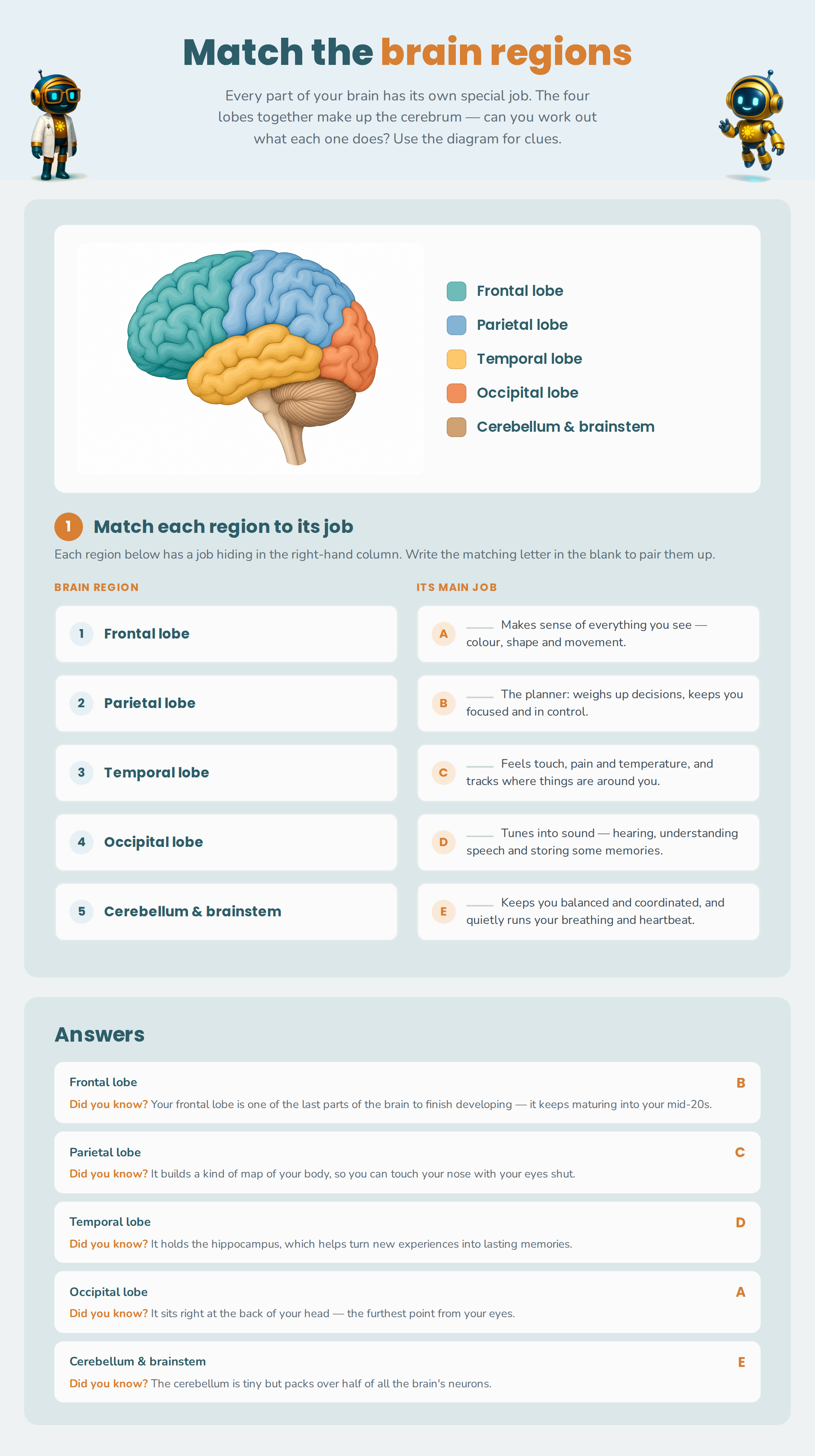
6. Most of your brain’s main vision area is at the back of your head, which is why a hard hit there can make you see stars.
True or false?
True — The occipital lobe, which processes vision, sits at the back of the brain. A strong impact there can disturb how those cells work for a moment, so people may see flashes or stars.
7. When you are awake, your brain can generate roughly 12 to 25 watts of electricity, which is enough to power a small light bulb.
True or false?
True — The brain’s electrical activity is strong enough that, in total, it can match the power needed for a small light bulb. Those tiny signals support everything from movement to thinking.