Information for families of young people with 22q11.2 deletion
BEAM is a research study at the Cardiff University Brain Research Imaging Centre (CUBRIC) looking at how the brain develops through late childhood and adolescence. We would love to hear from families whose child has a 22q11.2 deletion and is aged between 8 and 14, and this page explains what taking part would involve.
THE BASICS
What is a copy number variant?
Our genes are carried on chromosomes, and most people have 23 pairs of them, with one chromosome in each pair coming from each parent. Each chromosome has a short arm, called p, and a long arm, called q, which meet at a narrow point called the centromere. The positions along each arm are numbered, which is how a particular section of a chromosome can be named.
Sometimes a small section of a chromosome is missing, which is called a deletion, or a section is repeated, which is called a duplication. These changes are known as copy number variants, or CNVs, and they are relatively common.
Most CNVs make no noticeable difference to a person’s health or development. A small number, known as neurodevelopmental or pathogenic CNVs, are linked to differences in health and development, and these are very rare.
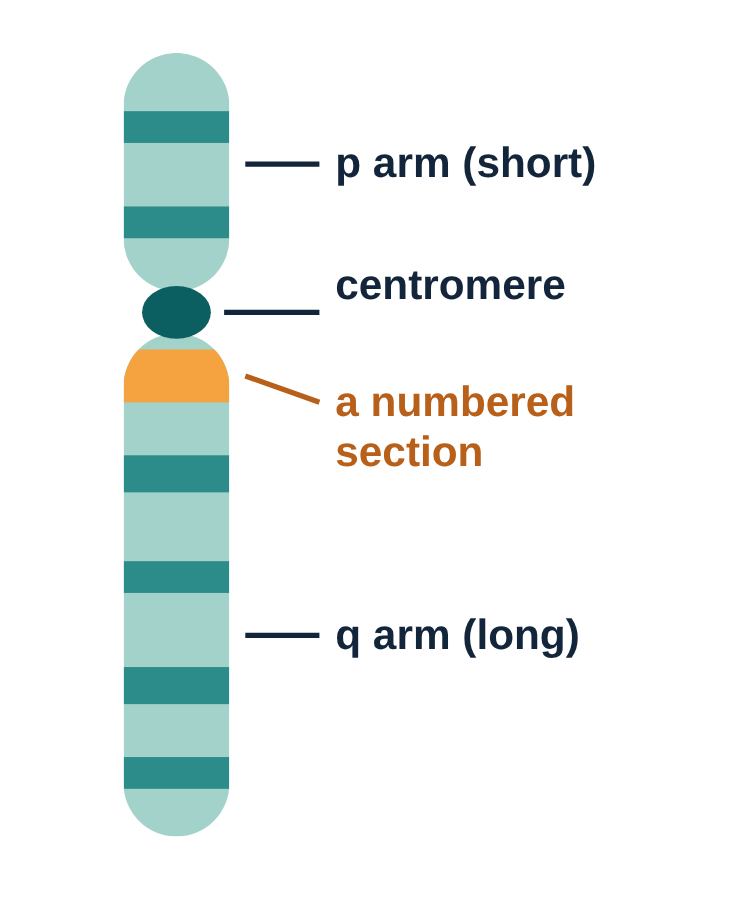
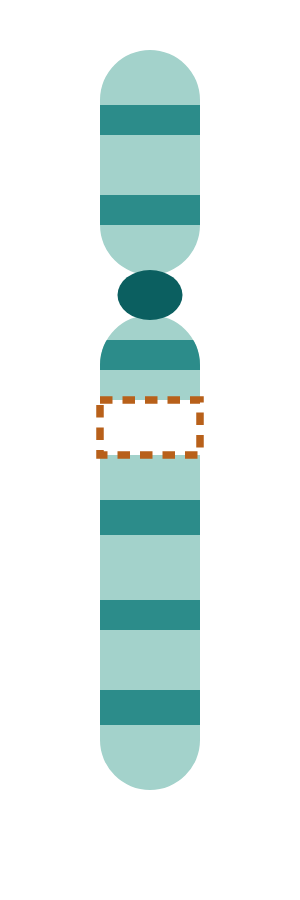
The parts of a chromosome
The light and dark bands help scientists find each numbered position.
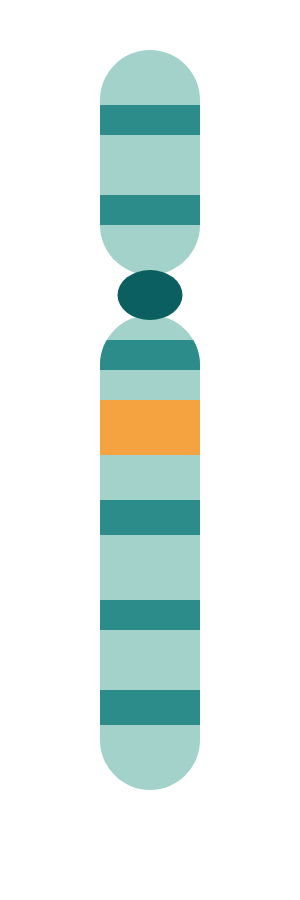
The usual pattern
Every section is present once, including the one shown in orange.
A deletion
A small section is missing, so there is one copy of those genes instead of two.
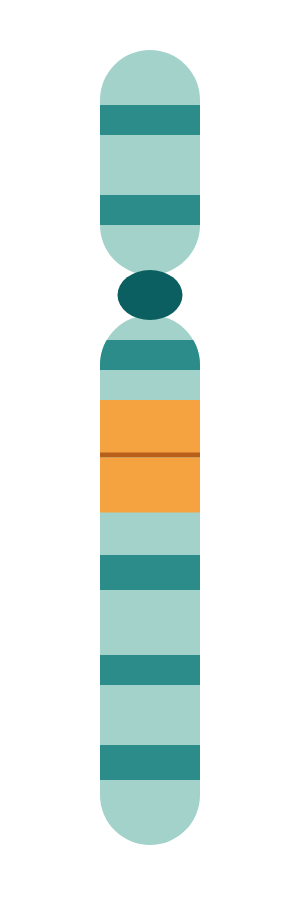
A duplication
A small section appears twice, so there are extra copies of those genes.
ONE TYPE OF CNV
What is 22q11.2 deletion?
22q11.2 deletion syndrome happens when a small piece is missing from one of the two copies of chromosome 22. The name tells you where the missing piece is found, on chromosome 22, on its long arm (known as q), at the position numbered 11.2. You may also have heard it called DiGeorge syndrome or velo-cardio-facial syndrome (VCFS).
In more than 90 per cent of cases the deletion is a new change that has happened for the first time in that child, which is known as de novo. In the remaining cases it has been passed on from a parent who also has the deletion, and sometimes a parent only finds out they have it after their child is diagnosed.
Every child with a 22q11.2 deletion is different, and the way it affects one young person can be quite unlike the way it affects another, even within the same family.
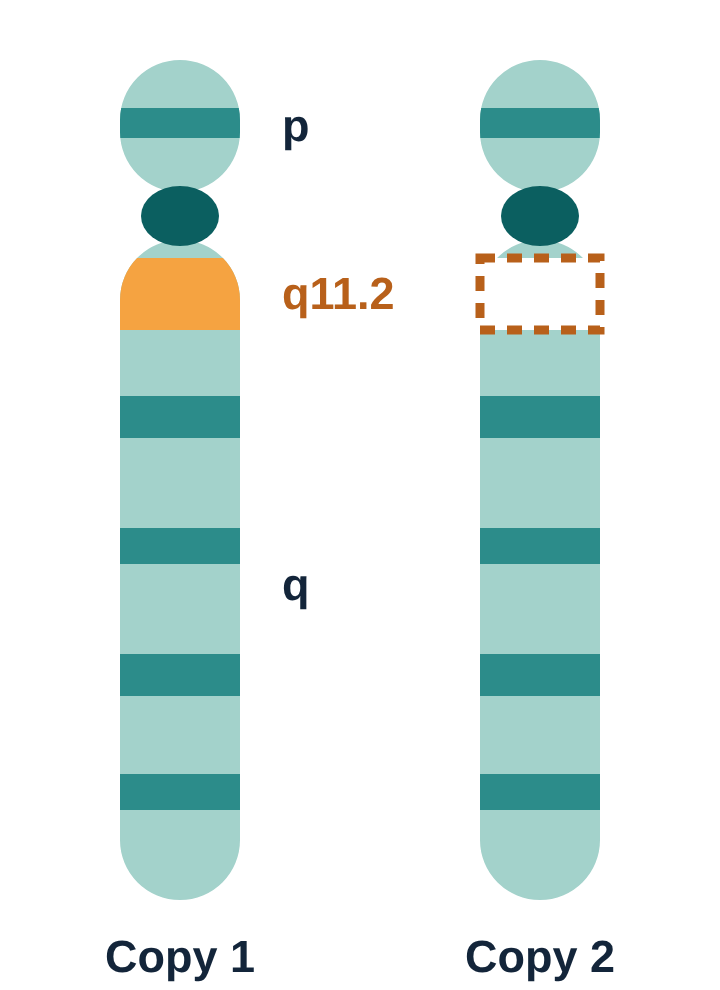
Orange marks the section at q11.2, just below the centromere. The dashed outline shows the same section missing from one copy.
About 1 in 2,000
people are thought to have a 22q11.2 deletion, and many may not yet be diagnosed.
30 to 40 genes
are usually included in the missing section, which is very small compared with the whole chromosome.
Information adapted from the Unique guide to 22q11.2 deletion syndrome (rarechromo.org).
How can 22q11.2 deletion affect a young person?
Every young person with a 22q11.2 deletion is different, and no one will have all of the things listed below. Some people are only mildly affected, while others need more support, but the following are more likely than in the general population.
Physical health
- Heart conditions, which affect around 7 in 10 people with the deletion
- Differences in the palate (roof of the mouth), which can make speech sound nasal
- Low calcium levels, particularly in babies
- More frequent infections, as the immune system may work less well
- Feeding difficulties in the early years, hearing differences and kidney differences
Learning and development
- Being a little later to sit, walk and talk
- Learning differences, which range from mild to more significant
- Finding maths, problem solving and abstract ideas harder, often alongside relative strengths in reading, spelling and memory
- Many children attend mainstream school, some with extra support in class
Wellbeing and mental health
- ADHD, which affects around a third to a half of children with the deletion
- Autism, which is diagnosed more often than in other children
- Anxiety and low mood, which can become more common in the teenage years
- A higher chance of conditions such as schizophrenia in later adolescence and adulthood, although most people with the deletion do not develop them
Information adapted from the Unique guide to 22q11.2 deletion syndrome (rarechromo.org). Your child’s own care team is the best source of advice about their health.
Why is BEAM inviting young people with 22q11.2 deletion?
Young people with 22q11.2 deletion are missing almost the same section of chromosome 22, which contains around 40 genes, yet they can be very different from one another in how they learn, think and feel. We still know very little about why this is, and BEAM hopes to help answer that question by looking closely at how the brain develops.
The teenage years are a time of big changes in the brain. Research has shown that differences in brain development between young people with and without 22q11.2 deletion tend to grow during adolescence, which is also when the chance of some mental health difficulties starts to rise. This makes it a particularly important time to study.
Looking in finer detail
Our Connectom and 7T scanners can show the brain’s wiring in much more detail than standard scans, down to the tiny structures that change as the brain matures.
Following young people as they grow
Seeing each young person three times, two years apart, lets us track how their brain changes through the teenage years.
Linking the brain to everyday life
We will look at how these brain changes relate to thinking skills, emotions and mental health, alongside young people without a genetic condition who also take part in BEAM.
We hope this will help with recognising young people’s needs earlier and finding better ways to support them in the future. An advisory group of parents and young people with 22q11.2 deletion and other CNVs recommended that families are offered a social story (a simple step-by-step guide that helps a child know what to expect) and a sensory map, which you will find further down this page.
TAKING PART
What would taking part look like if your child has 22q11.2 deletion?
Families visit us at CUBRIC in Cardiff three times, with two years between each visit. Each visit generally takes a full day, however we can spread this out over two days with an overnight stay to allow plenty of time for breaks. Visits can be arranged at weekends or during school holidays where possible.
Before each visit, a parent or carer fills in a questionnaire pack that takes about an hour. Your child does not need to be with you while you complete it, and you can save your answers and come back to it later.

Three visits
Two years apart, so we can see how the brain changes as your child grows.

Overnight stay
Accommodation is paid for by the study, so the visit can be spread over two days.

Travel
Travel and food costs are reimbursed in line with Cardiff University’s expenses policy.

£50 voucher
For every visit, as a thank you for your time.

Personal reports
Based on your child’s assessments.

A typical visit, step by step
This is written for your child to read with you. Not every visit will look exactly the same, as we will be flexible around your child, and we can send you a personalised social story before your visit.
 Some of the BEAM team will meet you when you arrive at CUBRIC in the morning.
 We will do some puzzles, computer games and questions together, and you can have lots of breaks.
 We will measure your height and weight and the size around your head.
 We may ask you to give a sample of spit in a tube.
 Then it is time for lunch and a rest.
 After lunch you can try our practice scanner, lying inside it and hearing the sounds it makes before you go in a real one.
 You will change into special clothes for the scan, and we might ask you to take off any make-up or nail polish.
 You will have a brain scan while keeping very still, and you can watch a film, wear headphones, come out for a break whenever you like and have a parent in the room with you.
 Finally it is time to go back to your hotel for the night.
The BEAM team will meet you again when you arrive in the morning.
You will change into the special clothes again for another scan.
You will have a scan in a different scanner, which works just like the practice scanner and the one from Day 1, and you can still watch a film, take breaks and have a parent with you.
That’s it, your visit is all done and you can head home. Thank you for coming to see us at BEAM, and we hope you enjoyed your visit!
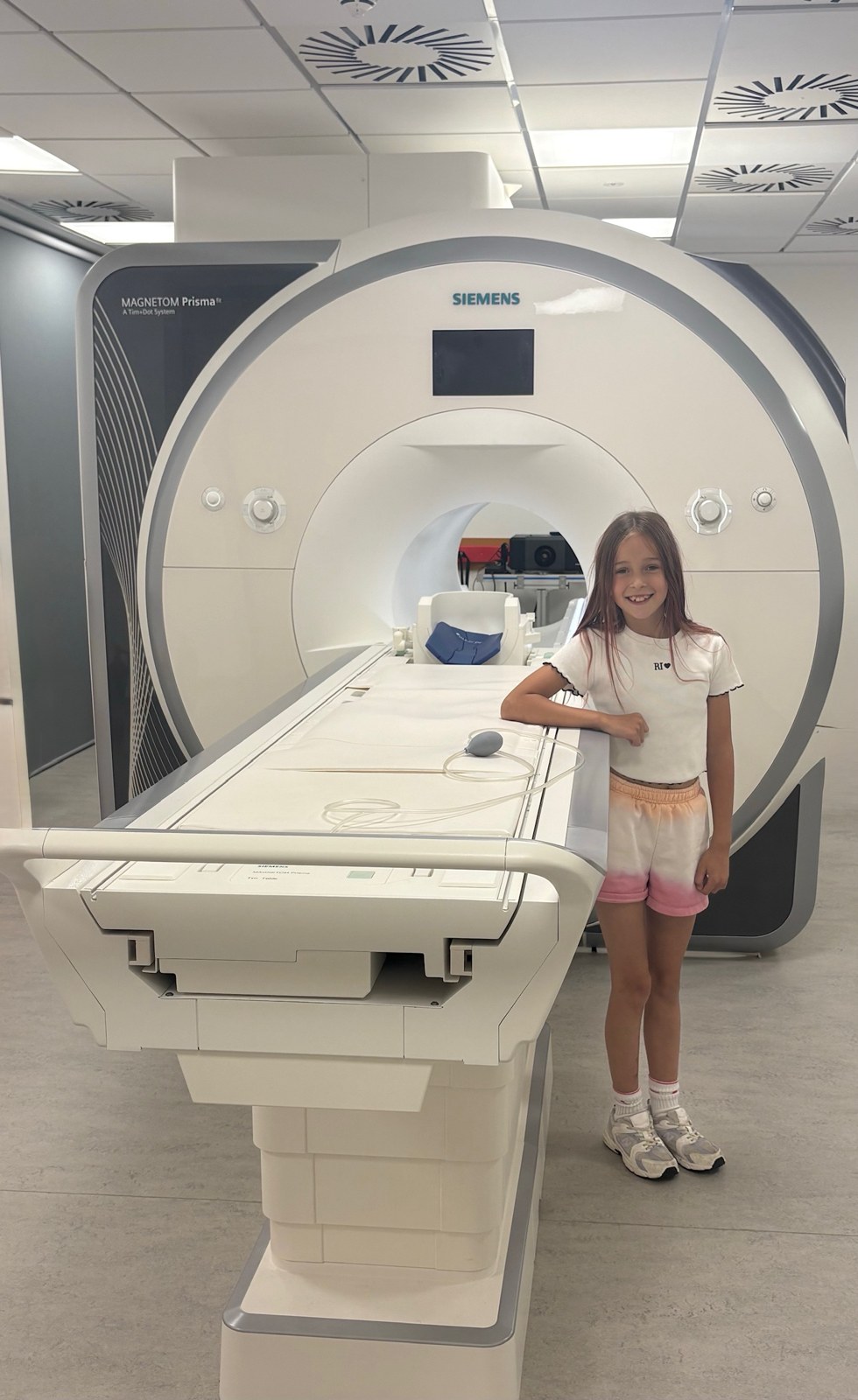
Trying out the scanner
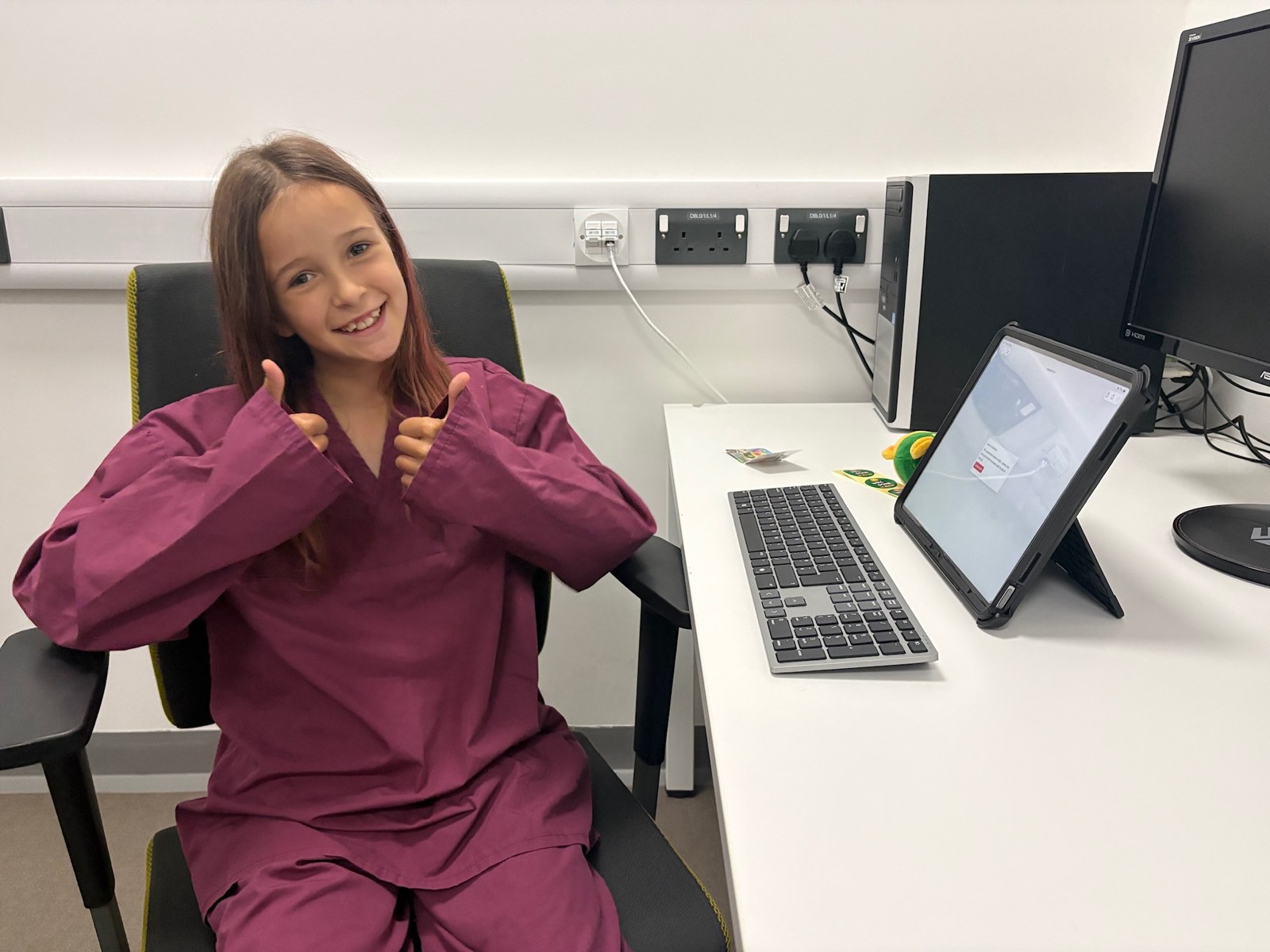
Ready for the puzzles and computer games
VISITING CUBRIC
Find the quiet places before you arrive
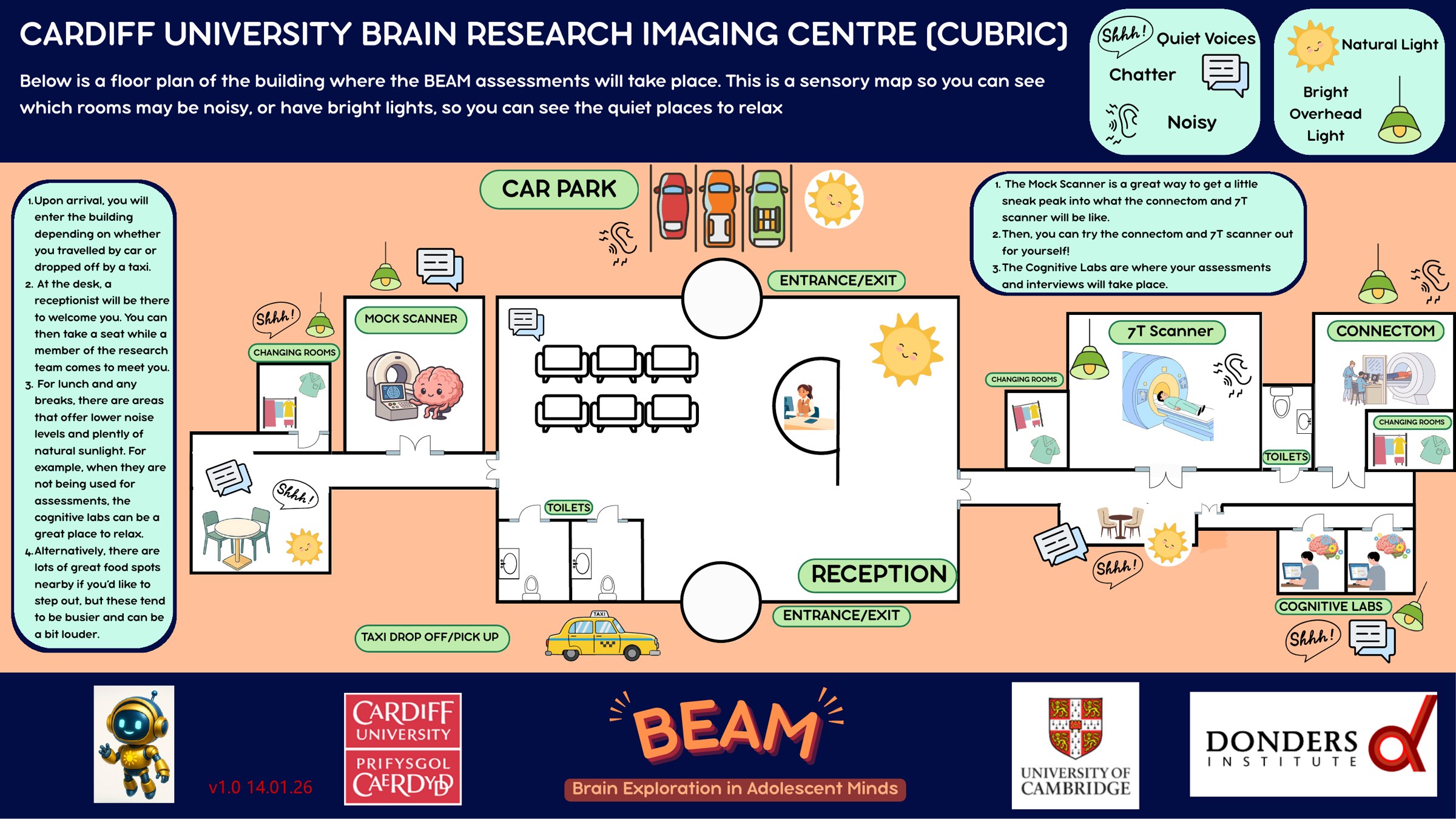
Our sensory map shows the building where BEAM visits take place, so you can see which rooms may be noisy or brightly lit and where the calmer spaces are.
- A receptionist will welcome you at the front desk, and you can take a seat while someone from the team comes to meet you.
- The scanner rooms are the noisiest part of the building.
- For lunch and breaks there are quieter spots with plenty of natural light, and the cognitive labs can be used to relax when they are free.
- There are places to eat nearby too, although these tend to be busier and louder.
Questions families often ask
Is an MRI scan safe for my child?
MRI uses a strong magnet and radio waves rather than X-rays, so there is no radiation involved. The team will go through some safety questions with you before each visit.
Can I stay with my child during the scan?
Yes, a parent can be in the scanner room with your child if they would like that.
What if my child finds it hard to keep still?
Your child can spend time in our practice scanner first, so the space and the sounds feel familiar before the real scan. During the scan they can watch a film, wear headphones and come out for a break whenever they need to.
What if my child wants to stop?
Your child can take a break or stop at any time, and you can withdraw from the study whenever you wish.
My child has extra support needs. Can you help?
Please tell us about anything that would make the visit easier for your child, and we will do our best to plan around it.
Who arranges the overnight stay?
The study pays for an overnight stay so the visit can be spread across two days.
Can brothers or sisters come along?
Yes, brothers and sisters are welcome to take part too.
How is my child’s information kept private?
All information is kept confidential and stored securely in line with data protection law.
Will my child need to miss school?
We have some limited availability at weekends and during school holidays. If your child does need to miss school, we can provide an absence letter.
What will we get from taking part?
Your child receives a £50 voucher for each visit, and travel, food and accommodation costs are covered. You will also receive a personalised report based on your child’s assessments.
Interested in taking part?
Filling in the expression of interest form does not commit you to anything, and a member of the team will get in touch to talk it through and answer any questions. You can also email us at BEAM@cardiff.ac.uk.
Support for families